
Short answer: in Magento vs Salesforce Commerce Cloud for B2B, choose Salesforce B2B Commerce if your CRM is where the business runs, and Adobe Commerce (Magento) if your ERP is the source of truth and you need code-level control. If you are a mid-market B2B seller led by your ERP, look first at a third option, Shopware, which gives you B2B features and open code without an enterprise-sized program.
You sell to businesses. Your buyers have contract prices, ship-to lists, credit terms and their own part numbers, all held in your ERP. Most comparisons you read talk about themes, AI search and market share.
This guide starts from the other end: what your ERP owns, how complicated your pricing is, how your buyers place orders, and who will own the code in three years. It is written for mid-market and enterprise B2B sellers, and for B2B and B2C sellers whose wholesale side drives the decision.

Quick verdict by buyer situation
Web Solutions NYC has built ecommerce since 2007. Today we build B2B commerce on Shopware, as a Shopware Platinum partner, and on Magento and Adobe Commerce. Most of our projects start with an ERP that owns price, stock and credit, and a storefront that has to respect it. We are not a Salesforce Commerce Cloud implementer, so every claim about it below comes from Salesforce’s own pages, and we tell you where to push in its demo.
Choosing between these three for an ERP-led business? Talk to us about your hardest account and we will show you how each one handles it.
Start with the option most comparisons leave out: Shopware

If you are a mid-market B2B seller, the Magento vs Salesforce choice may be a choice between two enterprise programs you do not need. We put it first because it is the platform we recommend most often to ERP-led B2B sellers. It is our main platform. Shopware describes itself as “Built on open source for B2B and B2C commerce”, with “Open source freedom. No lock-in.” It runs as SaaS, as PaaS, or on your own infrastructure.
“We have three different tiered trade customers, so they’ll have different pricing. And sometimes they’ll phone us and get a quote on an order.”
A buyer on a sales call: web project manager, safety equipment seller
B2B features
Shopware’s B2B components cover:
- Employee management: each business partner manages its own users and roles.
- Quote management: sales reps negotiate quotes with customers.
- Order approval: an approval workflow for controlled buying.
- Individual pricing: catalog-wide discounts and special pricing, including volume pricing and company-specific pricing agreements.
- Quick order and shopping lists: for repeat B2B buying.
- Organization units: differentiated access rights for companies with complex structures.
- Sales Agent: reps create orders and quotes on behalf of assigned customers.
Each B2B component can be switched on or off for each customer, in the Customer-specific features section of the customer record.
ERP fit and how it charges
Per Shopware’s pricing page, the Beyond plan adds customer-specific pricing that brings agreed prices from your ERP into Shopware via API, so each buyer sees their own price at login, and ready-made connectors for ERP, CRM and PIM systems are offered through its Shopware Nexus add-on. B2B components such as quotes and purchasing approvals start at Evolve; plans are priced on GMV and further individual factors.
Where it fits, honestly
Shopware fits mid-market B2B and B2B and B2C sellers who want strong B2B features, an open codebase and a build sized for the mid-market. It is a weaker fit if your organization is standardized on Salesforce and wants commerce inside the CRM, and its US partner and extension ecosystem is smaller than Adobe’s. See Shopware B2B ecommerce, our Shopware practice and Shopware vs Magento for B2B.

What Magento and Salesforce Commerce Cloud are
Salesforce B2C Commerce is built for consumer brands: Salesforce describes a multi-tenant architecture, multi-site management from Business Manager, and shared or site-specific price books, catalogs and promotions. Salesforce B2B Commerce is built for selling to businesses: account and buyer entitlements, negotiated pricing, personalized catalogs, buying on behalf of other accounts, split shipments and headless Commerce APIs. Its pitch is the connection to the rest of Salesforce: “The only B2B Commerce platform that comes connected right out of the box.”
When someone says “Magento vs Salesforce”, ask which Salesforce product they mean. For most B2B sellers it should be B2B Commerce. See our Magento development page for how we work with Adobe Commerce.
Head to head: B2B features
The table compares Adobe Commerce with the B2B extension against Salesforce B2B Commerce, using only what each vendor’s own pages say. “Not stated” means we did not find it on the vendor pages we read, not that it is missing. Ask in the demo.
| B2B need | Adobe Commerce (B2B extension) | Salesforce B2B Commerce |
|---|---|---|
| Company accounts | Company accounts with divisions, users, roles and permissions; hierarchy for parent and subsidiary companies | Account and buyer entitlements; buyers can purchase on behalf of other accounts or locations |
| Contract pricing | Shared catalogs set custom prices per product for different companies | Negotiated pricing and personalized catalogs |
| Quotes | Negotiable quotes started by the buyer from the cart or by a rep in the Admin, with negotiation history | Quotes and complex configurations brought together with Sales through native connectivity |
| Fast reordering | Quick Order by SKU and requisition lists | Reorder with pre-negotiated pricing, including through Agentforce skills for buyers |
| Purchase approvals | Purchase orders with approval rules by role | Not stated on the pages we read |
| Credit and terms | Pay on Account against a company credit line | Not stated on the pages we read |
| Large orders | Not stated on the pages we read | Split large-volume orders into multiple shipments and speeds |
| CRM connection | Integrations with CRMs, ERPs and PIMs through APIs, events and App Builder | Native connection to Salesforce Sales, Service and Marketing |
| Storefront | Reference storefront or PWA Studio on PaaS; Commerce Storefront on Edge Delivery Services on SaaS | Prebuilt templates and headless Commerce APIs |
Both cover the core B2B list. Adobe Commerce keeps the B2B logic inside the commerce platform; Salesforce B2B Commerce keeps it next to your CRM. For more on the Adobe side, read our Adobe Commerce B2B module guide and our guide to B2B quoting and RFQ workflows.
Head to head: ERP integration
Your ERP usually owns five things: customer accounts and ship-tos, contract pricing, available stock by warehouse, credit limit and terms, and the order once it is placed. Whatever platform you choose, those five flows have to be built and owned by someone.
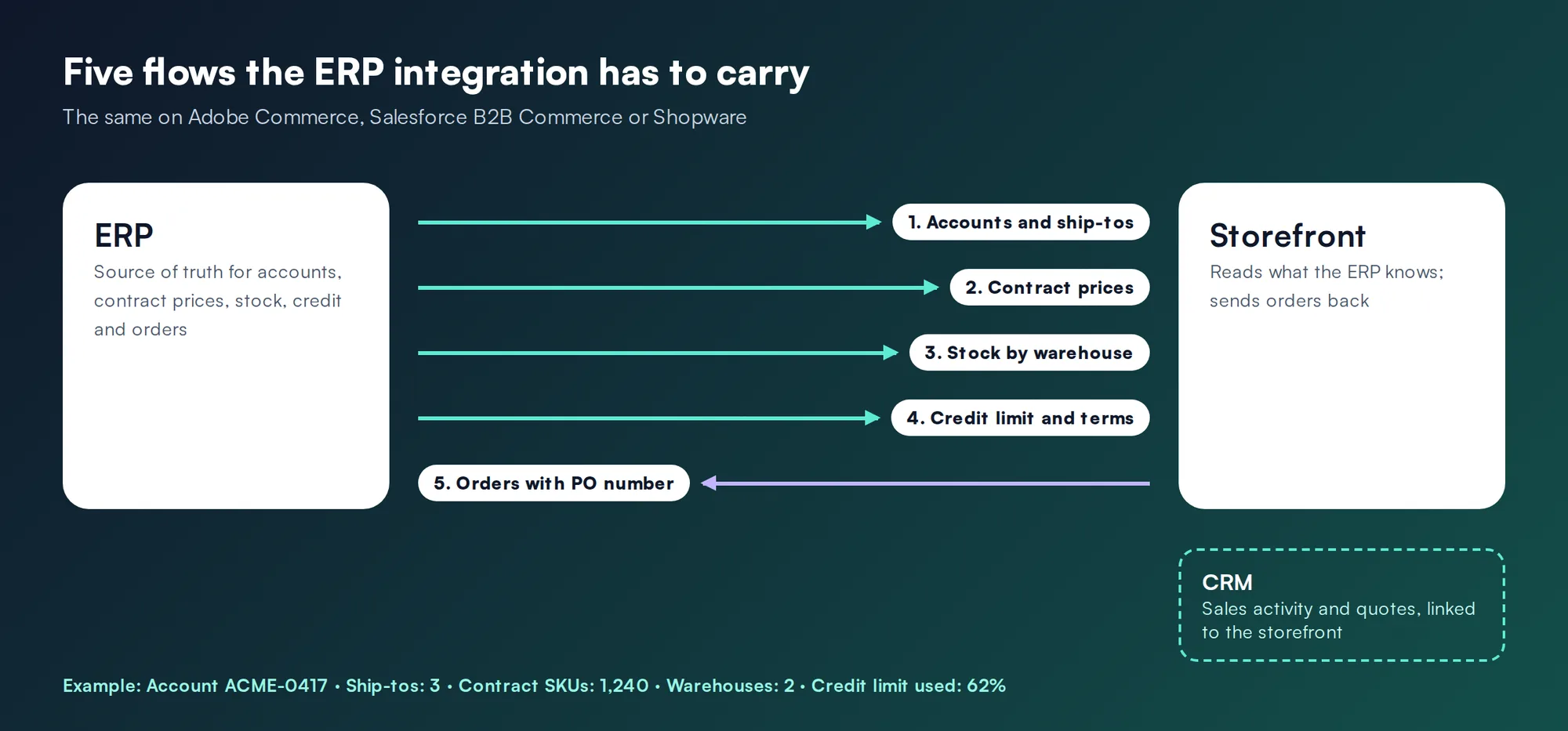
Our ERP ecommerce integration guide covers how we plan these flows, and account-specific pricing and ERP sync goes deeper on contract prices.
Head to head: who owns the code, and how upgrades work
Adobe Commerce on PaaS or on-premises. You own the customizations. Adobe’s comparison lists complete data model customization and in-process PHP customization. The trade-off is upkeep: Adobe’s comparison says of this model, “Requires manual upgrade and patching. Six patch releases and one minor release per year.” Each release line gets a three-year standard support window, and per its lifecycle policy Adobe has announced an enforced upgrade policy for its Cloud environments starting June 1, 2027.
Adobe Commerce as a Cloud Service (SaaS). Adobe upgrades it automatically through what it calls “a versionless SaaS model”. Customization moves out of process: APIs, events and App Builder. Adobe also notes the SaaS model does not support Luma storefronts, and that industry-specific data models may need extra architecture work.
Salesforce Commerce Cloud. Salesforce runs the platform. B2C Commerce is described as multi-tenant, with dedicated staging and development environments. B2B Commerce offers templates, custom fields and headless APIs. You configure and extend inside Salesforce’s platform rather than owning a full codebase.

“They’ll do an update to the server… and all of a sudden, we can’t save our products when we change them.”
A buyer on a sales call: web project manager, safety equipment seller on Magento
“Everything is possible because it’s open source. However, not everything should be done in Magento.”
Yitz Lieblich, founder, Web Solutions NYC
Settle early whether you want to own the code and its upkeep, or rent a platform and accept its limits.
Head to head: how each charges
We do not publish prices for any vendor. This is how each one charges, from their own pages.
- Shopware: the open-source Community Edition has no license fee. Paid plans are priced on gross merchandise value (GMV) and further individual factors.
- Magento Open Source: released under the OSL 3.0 open-source license. You pay for the build, the infrastructure and the upkeep.
- Adobe Commerce: licensed from Adobe under a paid agreement. Ask Adobe how the fee is calculated for your model, SaaS or PaaS. Our Magento pricing guide covers the cost of the build around it.
- Salesforce Commerce Cloud: each edition on Salesforce’s pricing page is listed as “Contact for pricing”. B2C Commerce and B2B Commerce are separate editions, and Order Management, Point of Sale and Payments are separate line items.
On any of them, compare the license, the build, the ERP integration and three years of upkeep, not the license alone.
Who fits which
| Your situation | Best fit | Why |
|---|---|---|
| Mid-market B2B or B2B and B2C, ERP-driven, open code wanted | Shopware | B2B components per customer, ERP pricing via API, a build sized for the mid-market |
| ERP owns complex pricing; you want to own the code | Adobe Commerce (PaaS or on-premises) | Full data model and checkout control |
| ERP owns pricing; you want the vendor to run upgrades | Adobe Commerce as a Cloud Service | Versionless upgrades, B2B pre-installed, out-of-process integration |
| Sales Cloud is your system of work; quotes start in the CRM | Salesforce B2B Commerce | Native link to Sales and Service |
| Consumer-first brand, many sites and currencies | Salesforce B2C Commerce or Adobe Commerce | Salesforce documents multi-site, multi-currency management; Adobe Commerce runs multiple websites |
“We were originally very much a B2C ecommerce website… We’ve outgrown it. We’ve also got a very significant B2B component now.”
A buyer on a sales call: marketing director, sporting goods seller
Weighing SaaS-first platforms too? See Magento vs Shopify Plus for B2B and Magento vs BigCommerce.
How to choose: four tests to run in the demo
Price your hardest account
Pick the customer with the most complicated pricing: contract prices, quantity breaks and their own part numbers. Ask each vendor to log in as that account and show the price your ERP would charge. If the answer is “we would build that”, ask who builds it and how long it takes.
Take a quote all the way to the ERP
Have the buyer request a quote, a rep counter it, the buyer accept it, and the order land in your ERP with the PO number, ship-to and terms intact. Watch every handoff.
Turn the ERP off
Ask what the storefront does when the ERP is slow or offline. Does checkout stop, or does it queue orders and show cached prices? Get the answer in writing.
Ask to see an upgrade
Ask who applies the next release, how many hours it takes, and what custom work it broke last time.

Proof: when the CRM was not the answer
Industrial equipment seller, quote-led buying on Magento
The seller’s products were high-value and sometimes rare, with price, availability and terms all negotiable. A standard cart with displayed prices broke their model: it exposed prices buyers could use as leverage and assumed every unit sold at the same price. Their process was fragmented. Marketing sent prospects to the website, quote history lived in email, and follow-ups happened in Salesforce.
On Magento, we replaced prices and buy buttons with a “Request a Quote” form on every product page. Requests flow into a quote dashboard where reps see each customer’s profile, past quotes and notes, create offers with custom prices, delivery terms and conditions, and counter-offer when a buyer declines. When the customer accepts, the order is created directly, with no checkout. Every request, offer, acceptance and decline is logged.
The lesson for this comparison: the seller already used Salesforce for follow-ups, but the quote and buying process was built in the commerce platform.

Conclusion
If you are a mid-market B2B seller led by your ERP, start with Shopware: B2B features switched on per customer, ERP pricing through its API, and open code. Choose Adobe Commerce if you are already invested in Magento or your pricing and buying flows need the deepest code-level control. Choose Salesforce B2B Commerce if your CRM is where your business runs and you are happy to configure inside Salesforce’s platform. Whichever you pick, scope the ERP integration first.
Frequently asked questions
Salesforce Commerce Cloud is Salesforce’s family of commerce products. It includes B2C Commerce for consumer brands and B2B Commerce for selling to businesses, plus Order Management, Point of Sale and Payments. Ask which product a comparison actually means.
Not exactly. Magento Open Source is the open-source code base Adobe publishes under the OSL 3.0 license. Adobe Commerce is Adobe’s licensed product, offered as SaaS, PaaS or on-premises, with a B2B extension for company accounts, quotes and shared catalogs. Many people still say “Magento” for both.
For B2B sellers, the usual alternatives are Shopware, Salesforce B2B Commerce, BigCommerce and Shopify Plus. Shopware is the closest fit if you want open code and native B2B features. Salesforce fits CRM-centered sellers. BigCommerce and Shopify Plus fit sellers who prefer SaaS and can work within platform limits.
No. Salesforce lists them as separate products with separate editions on its pricing page. B2C Commerce targets consumer brands with multi-site, multi-currency storefronts. B2B Commerce targets business buyers with account entitlements, negotiated pricing, personalized catalogs and a native connection to Salesforce Sales and Service.
Yes. Adobe documents REST and GraphQL APIs, events, webhooks and App Builder for integrating Adobe Commerce with CRMs, ERPs and PIMs. A common pattern is the ERP owning price, stock and orders, the CRM owning the sales relationship, and the storefront reading from both.
Weighing Magento, Salesforce or Shopware for B2B?
Bring us your hardest account: the most buyers, its own part numbers and contract pricing. We will show you how Shopware and Adobe Commerce handle it with your ERP, and tell you honestly when Salesforce is the better fit.
Let’s talkSources
- Adobe Experience League: Introduction to Adobe Commerce B2B
- Adobe Experience League: Cloud Service vs PaaS feature comparison
- Adobe Experience League: Adobe Commerce as a Cloud Service
- Adobe Experience League: Lifecycle policy
- Magento Open Source project page (GitHub)
- Shopware developer documentation: B2B components
- Shopware: plans and pricing
- Salesforce: Commerce Cloud, B2B Commerce, B2C Commerce and Commerce pricing pages, salesforce.com
All sources checked October 2026.
Related guides
Adobe, Adobe Commerce and Magento are trademarks of Adobe. Salesforce and Commerce Cloud are trademarks of Salesforce, Inc. Shopware is a trademark of shopware AG. Product names are used to identify the products discussed.